
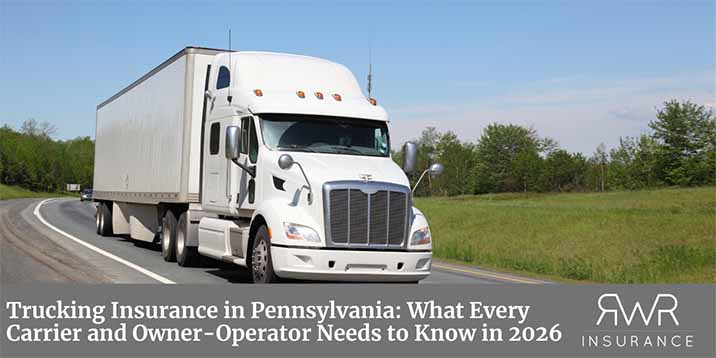
Pennsylvania is one of the most active trucking corridors in the country. From the I-78 and I-81 freight lanes cutting through the south-central part of the state, to the I-76 Pennsylvania Turnpike connecting Pittsburgh and Philadelphia, to the dense industrial routes threading through the Lehigh Valley and around Harrisburg—if you’re running trucks in this state, you’re operating in serious commercial territory.
That also means you’re operating under serious scrutiny. Pennsylvania has its own regulatory requirements layered on top of federal FMCSA rules, and the cost of a gap in coverage—financially, legally, and operationally—can be severe. At Reed, Wertz and Roadman, we’ve been helping Pennsylvania trucking operations get their insurance right for years. This post covers what you need to know about trucking coverage in 2026: what’s required, what’s often missed, and how to make sure your operation is fully protected.
Federal and Pennsylvania Requirements: The Baseline
Before we get into the nuances, let’s establish the floor. Every for-hire motor carrier operating in interstate commerce must meet FMCSA minimum liability requirements. For most general freight operations, that’s $750,000 in primary auto liability. For carriers hauling hazardous materials, those minimums jump to $1,000,000 or $5,000,000 depending on the commodity. Household goods carriers have their own threshold at $300,000.
Within Pennsylvania, intrastate carriers—those operating exclusively within state lines—are regulated by the Pennsylvania Public Utility Commission (PUC) and must maintain filings that satisfy PUC requirements. If you’re running both intrastate and interstate, both sets of rules apply.
These are minimums. In practice, most shippers, brokers, and freight contracts require significantly higher limits—often $1,000,000 or more in primary liability regardless of cargo type. If your current policy is sitting at the federal floor, it’s worth a conversation about whether that’s actually sufficient for the loads you’re hauling and the contracts you’re signing.
The Core Coverages Every Pennsylvania Trucking Operation Needs
Primary Auto Liability
This is the policy that pays when your truck is involved in an accident and you’re at fault. It covers bodily injury and property damage to third parties. For most Pennsylvania carriers, the practical minimum for getting freight contracts is $1,000,000 per occurrence—the federal floor is a starting point, not a target.
Physical Damage
Primary liability protects others. Physical damage coverage—collision and comprehensive—protects your equipment. In Pennsylvania, where road conditions range from the well-maintained Turnpike to heavily used local routes that take a beating every winter, equipment damage is not a hypothetical. If you’re financing your trucks, your lender requires physical damage coverage. Even if you own your fleet outright, replacing a total-loss tractor out of pocket is a business-threatening event.
Motor Truck Cargo
Cargo insurance covers the freight you’re hauling if it’s damaged, stolen, or destroyed while in your possession. Most shippers and brokers require a minimum of $100,000 in cargo coverage, though high-value loads often require more. Policies vary significantly in terms of what’s covered and what’s excluded—refrigeration breakdown, loading and unloading, and specific commodity exclusions are all areas where truckers sometimes discover gaps at the worst possible time.
General Liability (Non-Trucking)
Trucking general liability covers your business for incidents that occur off the road—slip-and-falls at your terminal, loading dock accidents, property damage during cargo handling, and similar exposures. This is distinct from your primary auto liability policy and is often required by shippers and terminal operators.
Bobtail and Non-Trucking Liability
Owner-operators leased to a motor carrier face a specific coverage gap: when you’re operating the truck outside the scope of the lease—deadheading home after a delivery, running a personal errand, or operating between loads—the carrier’s primary liability policy may not cover you. Bobtail and non-trucking liability fill that gap. If you’re an owner-operator, this coverage is not optional.
Workers’ Compensation
Pennsylvania requires employers to carry workers’ compensation for their employees, and trucking operations are no exception. The classification of your drivers—employee vs. independent contractor—has significant implications for your comp obligations, and it’s an area where trucking companies sometimes find themselves in compliance trouble. Owner-operators should also consider occupational accident coverage as an alternative if they operate as independent contractors.
Umbrella / Excess Liability
Given the catastrophic loss potential of a serious truck accident, a commercial umbrella policy that extends above your primary liability limits is strongly recommended for any trucking operation with meaningful revenue or assets. Many freight brokers now require $1,000,000 in umbrella coverage as a condition of dispatch, and that number is trending upward.
Pennsylvania-Specific Considerations for Trucking Operations
The Pennsylvania Turnpike and High-Traffic Corridors
Operating on the Pennsylvania Turnpike (I-76), I-78, I-81, or I-83 puts your trucks in some of the highest-volume freight traffic in the Northeast. Accident frequency on these corridors is elevated, and insurers price accordingly. If your routes are concentrated on these highways, your insurer needs to know—and your coverage should reflect the actual exposure.
Weight and Axle Compliance
Pennsylvania enforces strict weight and axle load limits, and violations can create liability complications in the event of an accident. An overweight truck involved in a crash in Pennsylvania can face arguments that the weight violation contributed to the accident or the road damage—which may affect how claims are handled. Keeping your operations in compliance isn’t just a regulatory issue; it’s an insurance issue.
Pennsylvania PUC Filings
Intrastate carriers regulated by the Pennsylvania PUC must maintain proper insurance filings with the commission. Lapses in filing—even brief ones caused by a carrier switch or a payment issue—can trigger operating authority suspension. If you’ve recently changed carriers or had any gaps in your policy, verifying your PUC filing status is a critical step.
Winter Operations and Physical Damage
Pennsylvania winters, particularly in the northern and central parts of the state, create meaningful physical damage exposure. Ice, black ice on mountain grades, and lake-effect snow in the northwest can all lead to equipment losses that are entirely weather-related. Make sure your physical damage policy covers weather-related incidents without exclusions that could leave you exposed.
Common Coverage Gaps We See in Pennsylvania Trucking Operations
These are the issues we encounter most often when reviewing trucking insurance programs for Pennsylvania-based operators:
- Liability limits set at federal minimums. Most freight contracts require more. Minimum compliance does not equal adequate protection.
- Cargo exclusions that don’t match actual hauls. Many carriers discover their cargo policy excludes the commodities they actually move. Review your exclusions against your actual freight.
- Owner-operators without bobtail coverage. The gap between lease coverage and personal operation is a well-known liability trap that still catches carriers off guard.
- Outdated equipment schedules. Policies that don’t reflect your actual fleet—because trucks were added, retired, or upgraded without notifying the insurer—can result in denied claims or coverage disputes.
- No hired and non-owned auto coverage. If your drivers occasionally use personal vehicles or rented equipment for business purposes, you need this coverage. Most primary auto policies don’t include it automatically.
- Lapsed PUC filings. As noted above, a lapse can suspend your operating authority. This is a paperwork problem with real operational consequences.
How Reed, Wertz and Roadman Helps Pennsylvania Trucking Operations
Our team works with trucking companies, owner-operators, and fleet operators across Pennsylvania. We understand the routes, the regulatory environment, the freight types, and the contract demands you’re navigating every day. As an independent agency, we represent multiple carriers and can shop your coverage to find the right combination of protection and price.
Whether you’re a single owner-operator running regional hauls out of Allentown, a mid-size fleet based in Harrisburg, or a larger operation running lanes up and down the East Coast from a Pennsylvania terminal, we can build a program that actually fits.
A trucking insurance review with Reed, Wertz and Roadman covers:
- Primary auto liability limits vs. your actual contract requirements
- Physical damage coverage and equipment schedule accuracy
- Cargo coverage and commodity-specific exclusions
- Workers’ compensation classification and compliance
- Owner-operator bobtail and non-trucking liability gaps
- PUC filing status and intrastate compliance
- Umbrella and excess liability adequacy
Talk to Reed, Wertz and Roadman About Your Pennsylvania Trucking Coverage
Trucking insurance is not a commodity. The right program for your operation depends on what you haul, where you run, how your drivers are classified, and what your contracts require. A generic policy from a carrier who doesn’t specialize in trucking can leave you exposed in ways you won’t discover until you have a claim.
Contact Reed, Wertz and Roadman to schedule a no-obligation review of your current trucking insurance program. We’ll identify gaps, compare your coverage against Pennsylvania requirements and your actual contracts, and put together options that make sense for your operation.